“Great Minds Think Alike” – The Game

“Great Minds Think Alike” – The Game
As a language teacher with generally three to four preps, I am on the lookout for engaging classroom activities that require (very) little prep and promote target language use.
The following activity is based on a popular German party game, “Zwei Doofe, ein Gedanke” (affectionately translated as “Two fools, one thought“—the playful German equivalent to “Great minds think alike“).
The premise is simple and relies on vocabulary recall. The game can be used as a warm-up, at the end of class , or for a bit of “Friday Fun”.
The best part of it is that it can easily be adapted to any language, proficiency level, or thematic unit you are currently teaching.
How to Play:
1. The teacher (or a designated student) names a broad category or prompt in the target language. For example: “A typical pizza topping“, “A piece of furniture“, “A mode of transportion (that goes on the street)“, “A computer game“, “A color“, “An animal“, “A profession that wears a uniform“, “Something you find in a school backpack,” etc.
Note: You (or a student) can say the prompt out loud or you can write / project it on the board.
2. Give the students a moment (if needed) to think about their answer. Then count down: “3… 2… 1…”.
3. On the signal, the students simultaneously shout out the first word that pops into their head.
Note: You can have them write down their answer instead of yelling it out.
–> Whiteboards lend themselves well to this activity!
On the signal, students hold up their whiteboard and you verify their responses.
4. The students, who yell out (or write) the same word as you (or the designated student), score a point!
- Note: You do NOT have to have a designated student, nor do the students need yell out (or write) the same word as you. Students simply receive a point for the number of students that had the same response.
For example: If you had 15 students in class
- If 8 students said (or wrote down) the same response, they would each get 8 points.
- That follows for the remaing students in the class.
- If 5 different students had the same response, they would each get 5 points.
- And if the remaining 2 students had the same response, they would each get 2 points.
- Remember! If a student is the only one with a certain response, that student gets 0 points, because they had no classmates with the same response.
Variations:
1. Have two students stand at the front of the room facing the class. Give them the category / prompt. Count down, and see if they can match. If they match, they stay up, but if they miss, two new students come up. (Students can either call out the answer or write it down on whiteboards.)
Option: If you don’t want students waiting around for their turn, pair the entire class up. Give the category / prompt to the whole class, count down, and have all pairs shout (or write) their answers to each other simultaneously. Partners keep track of how many times they successfully have the same response during a (5-minute) round.
2. For intermediate or advanced classes, challenge them to avoid the most obvious answers.
- Pick a category / prompt and think of the ‘most obvious answer’, but do NOT tell the class!
- If a student responds with the ‘most obvious answer’ that you chose, the student does NOT get a point. (Conversely, if they chose a different answer than the ‘most obvious answer’, they get a point.)
For example:
- For the category “Something green“, you choose the ‘most obvious answer’ to be “Grass”. If a students says “Grass,” they do NOT get a point. (If they say another word like “Frog” or “Spinach”, they win a point.)
3. Once your students are comfortable with the activity and have done it multiple times, have them write the prompts. You can have them:
- Create and share slides with you.t (or prompts) on it.
- Use whiteboards and have them write a prompt (or prompts) on it.
- You can make it a whole class activity by having a student read a prompt out loud. (The student can also hold their whiteboard up and show the class, so the class can read the prompt also.)
- The class can write their response on their own whiteboards or say their responses aloud.
- Then, move to the next student and continue the process until each student has had a chance to share their prompt.
- Then, move to the next student and continue the process until each student has had a chance to share their prompt.
- The class can write their response on their own whiteboards or say their responses aloud.
- Note: You can also have them do this in groups, if you don’t want to make it a whole class activity.
German Teachers (and those who would like to see example slides): Here is a link to 150 Google slides (in German) that you can use right away in your classroom! (It will force a copy!)
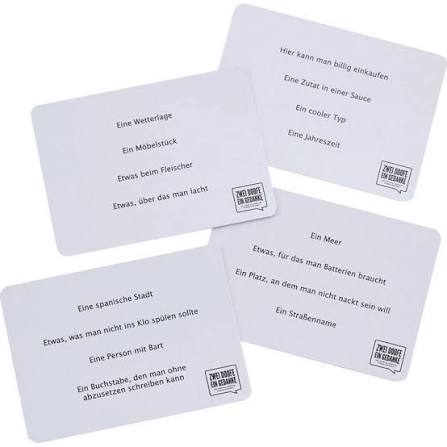
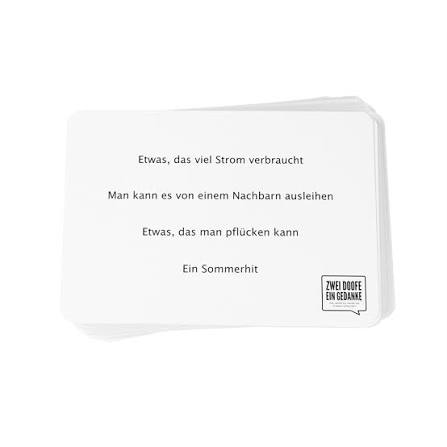
This game is great for vocabulary recall and creating an energetic community atmosphere in your classroom. If you give it a try, let me know how it goes in the comments below!
